Wednesday, April 13, 2011

Angular Velocity and Angular Acceleration

Angular acceleration 

Angular velocity

Angular Acceleration

Definitionrate of change of angular velocity over time.


SI Unit  : radians per second squared (rad/s2)


Direction  : perpendicular to the plane in which the rotation takes place.


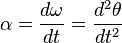
Symbol  : alpha (α)


Equation  : {\alpha} = \frac{d{\omega}}{dt} = \frac{d^2{\theta}}{dt^2} 


Constant acceleration : 

For all constant values of the torque, τ, of an object, the angular acceleration will also be constant. For this special case of constant angular acceleration, the above equation will produce a definitive, constant value for the angular acceleration:
{\alpha} = \frac{\tau}{I}.

]Non-constant acceleration : 

For any non-constant torque, the angular acceleration of an object will change with time. The equation becomes a differential equation instead of a constant value.
                                              
                                 LINEAR                                 ANGULAR
                              

Example 1 : 

An airplane propellor spins up from zero to 3000rpm (314rad/s) in ten seconds. What is its angular acceleration in rad/s?

 = (314rad/s - 0)/(10s)
 = 31.4rad/s.

Angular Velocity

Definition : Angular velocity is a vector quantity which specifies the angular speed of an object and the axis about which the object is rotating.


SI Unit  :  radians per second, degrees per second, revolutions per second, revolutions per minute.


Direction  : perpendicular to the plane of rotations.


Symbol : omega (ω, rarely Ω).


Equations :       


Angular Velocity of A Particle


Average Velocity = Circumference of the Circle/Time
Average Speed/Velocity = 2πr/T where, T is the period of the system and r is the radius of the revolution.
                              ω=2π/T=2πf
 where, f is frequency and T is the period
Example  1
A calesa with wheels whose diameter is 1.5 meters is traveling at 24 kph. Find the angular velocity of the wheel  in revolutions per minute.

Radius ( r )   =  1.5/2 
                      = 0 .75 (1/1000)   
                      =   0.00075 km
Linear Velocity (V)  =    24 kph

Angular Velocity (W)  =   ?   in revolution  per minute
 V  =   r W     
 W  =   V/r

W  =  (24 km/hr )(1/.00075 km)   =   32,000 radians  per hour

To convert to revolution per minute :

(32,000  rad/hr) (1 rev/2∏) (1 hr/60 min)  = 32,000/376.992   =   84.88

Example 2 : 
Suppose a point on a circle with radius  6  cm moves around a circle with angular velocity  of  2∏/5  rad/sec. What is the length of the arc generated after 10 seconds ?

 Radius  ( r )  =  6 cm
 Angular Velocity (W )  = 2∏/5  rad/sec
 Time ( t )   =  10  seconds
 S  =   ?  arc length

V  = r W
    =   (6 cm ) (2) (3.1416)/5  
    =   7.54  cm/sec

 S  =  Vt   
 S  =  ( 7.54 cm/sec) (10 sec) 
     =   75.4  cm

Example 3 : 
A ferriswheel has a diameter of  10 meters. It is rotating at the rate of  500 m/min. Find its angular velocity in rad/sec.

Radius ( r )  =  10/2 
                    = 5 m
 Velocity (V ) = 500 m/min
 W  =  ?

W  =   V/r
W  =   (500m/min )/5m 
     =  100 rad/min
     = (100 rad/min) (1 min/60 sec) 
     = 100/60 rad/sec
     =  1.7 rad/sec

Sunday, April 10, 2011

Average Angular Velocity

Average Angular acceleration,αav

Definition
Average angular acceleration,αav is defined as the rate of change of angular velocity.
Where:
                         ω2: final angular velocity
                        ω1: initial angular velocity
                        ∆t:time interval
                                      
average angular velocity,ωav
definition:
average angular velocity,ωav is defined as the rate of change of angular displacement
                        
where:
             Ɵ2:final angular displacement in radian
             Ɵ1:initial angular4 displacement in radian
              t:time interval

Example 2  :
express (a) 100 revolutions per minute (rpm) in rad s-1
              (b)25 rad s-1 in revolution per second
Solution:1rev=2ᴨ rad and 1 rpm =  rad s-1
(a)             100 rpmrad s-1
1st method;
100 rpm=  X  X    =10.47rad s-1
2nd method;
100 rpm=100X  rad s-1 = 10.47 s-1


Example 3 : 
If the angular the displacement,Ɵ of rotating wheel is given by
                   Ɵ=2Π+  
Determine,
                               I.            the average angular velocity at time t1=3.0 s and t2=5.0 s
                             II.            instantaneous angular velocity at time t=5.0 s
Angular acceleration is the vector of quantity. The unit of angular acceleration is the rads. If the angular acceleration α, is the positive then the angular velocity ω, is increasing. If the angular acceleration α,is the negative then the angular velocity  ω,is decreasing.

Angular acceleration
2.instantaneous angular acceleration,α
Definition:
Instantaneous angular acceleration is defined as the instantaneous rate of change of angular velocity.             
Example 4:
The instantaneous angular velocity,ω of the bicyle wheel is given by
              ω =6t3+2t2
calculate,
a.the instantaneous angular velocity at time,t = 2.0 s
Instantaneous angular velocity,ω=6t3=2t2
a) ω at time,t=2.0 s
    ω=6t3+2t2=6(2)3+2(2)2=56 rad s-1
   
 at time,t=2.0 s
   ω1=6(2.0)3+2(2.0)2→ω1=56 rad s-1

at time,t2=5.0 s
  ω2=6(5.0)3+2(5.0)2→ω2=800 rad s-1